
Our Maths Curriculum:
Why teach Maths?
Maths is the foundation for understanding the world around us. Through the teaching of Maths, our intent is to ensure that our children know the purpose behind their learning and then apply that knowledge to their own everyday lives.
We’ve put our children’s needs, interests and futures at the heart of our maths curriculum. The result is a curriculum for all that is creative and engaging, making use of high-quality resources and professional development opportunities to enrich our teaching and learning of maths.
With an emphasis on vocabulary in mathematics, children use appropriate mathematical talk to communicate and engage in discussions. It is important to us to develop confident mathematicians who are resilient in their learning and feel safe to take risks as they develop their ability to problem solve, reason, think logically and work systematically.
How we teach Maths
Our curriculum is built on the National Curriculum and the White Rose Scheme, which we then underpin with NCETM (National Council for Excellence in the Teaching of Mathematics) and the Department for Education’s maths guidance to ensure all of our children are ready to progress to the next step in their learning. The fundamental idea behind our curriculum design is to support our children to be able to perform simpler tasks so they can then move on to perform more complex tasks. Through this ‘small step’ teaching approach we support our children to develop the necessary skills to become ‘deep thinkers’.
Learning across the year is linked, ensuring there a plenty of opportunities to revisit core skills and apply learning from other topics within maths. This approach means that our children are able to make rich connections and acquire skills that can be recalled quickly and be transferred and applied in different contexts in Maths and more widely.
Children are taught in mixed ability whole class lessons, with targeted support for those struggling or for those needing deeper challenge. We ensure that maths is taught in creative and engaging ways. Wherever possible, mathematical concepts are introduced and explored within everyday contexts, giving children the chance to experience hands-on learning.
Our aim is to ensure that the three core areas of the national curriculum are covered in all our lessons: fluency, reasoning and problem-solving. Children get to practice their maths skills regularly, with a focus on developing their ability to recall and apply their knowledge rapidly and accurately. As well as a daily maths lesson, we teach daily ‘arithmetic’ lessons which focus on calculation and fluency, as well as continually recapping prior knowledge.
What your child will learn
- To talk confidently about Maths and their learning, relating it to real-life purposes.
- Use acquired vocabulary in lessons and discussions
- Use mathematical methods independently and show perseverance when tackling problems.
- Use different representations of mathematical concepts.
White Rose Maths Progression Maps
Multiplication Progression Map
Mastering Number
We use this programme to develop solid number sense, including fluency and flexibility with number facts, which will have a lasting impact on future learning for all children.
Pupils will:
- develop fluency in calculation and a confidence and flexibility with number that exemplifies good number sense
- be able to clearly communicate their mathematical ideas
- make good progress towards the Early Learning Goals and Year Group Expectations
- demonstrate a positive attitude towards maths•demonstrate a willingness to ‘have a go’
Mastering Number Reception Overview
Mastering Number Year 1 Overview
Mastering Number Year 2 Overview
Parents/Carers Workshops
Mastering Number at Home
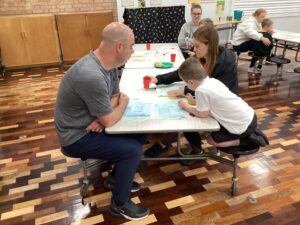
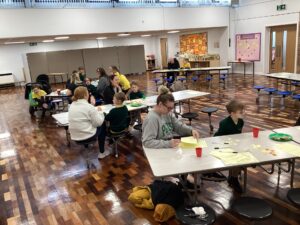
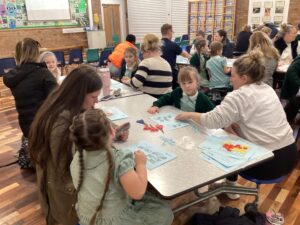
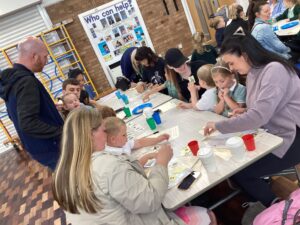
Our Mastering Number workshops have demonstrated to our parents/carers how they can support their children with maths at home.




Examples of Learning


