
Our Geography Curriculum:
‘You can travel the seas, poles and deserts and see nothing. To really understand the world, you need to get under the skin of the people and places. In other words, learn about geography. I can’t imagine a subject more relevant in schools.’
Michael Palin
Why teach Geography?
Geography inspires pupils to be curious and fascinated about the world around them and its inhabitants and our hope is that this sense of curiosity will remain with pupils for the rest of their lives.
The children develop their knowledge of the world around them through lots of opportunities to explore their rich and diverse local environment and learn about global natural and human environments.
Alongside this children will develop a deep understanding of the Earth’s key physical and human features and processes. Over time, the children’s growing knowledge about the world should help them deepen their understanding of the interaction between physical and human features and processes, and of the formation and use of land and environments.
How we teach Geography
At the beginning of every topic, pupils begin with an overarching enquiry question and discussion, which ensures that our teaching is informed by the children’s prior knowledge. It is enquiry based and the pupils have an opportunity to explore a range of resources, texts and experiences. There are regular opportunities for all pupils to carry out field work to enable them to experience their local area and beyond. We use high quality resources such as maps, compasses, atlases and we also have a carefully planned programme of visitors, workshops and visits.
What your child will learn
- A secure understanding of the world around them and how it has been shaped.
- Knowledge of the location of places, seas and oceans, including their defining physical and human characteristics.
- An understanding of the physical and human geographical features of our local area, West Derby and our city, Liverpool.
- A range of geographical skills, including collecting and analysing data gathered through fieldwork that deepen understanding of geographical processes.
- The ability to interpret a range of sources of geographical information, including maps, diagrams, globes and aerial photographs
Examples of Children’s Work:
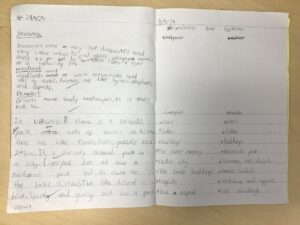
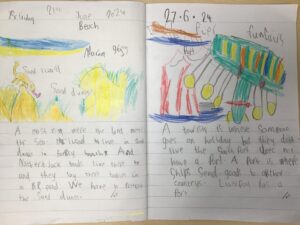

Examples of Learning


